| english version | vai alla versione italiana |
The American imaginary is one of travel, of frontiers to reach and spaces to traverse. It has been so since before Kerouac’s On the Road,’ since the gold rush, the expansion into the wild territories to the west that Larry McMurtry depicted in novels like Dead Man’s Walk and Comanche Moon, and the forays into the cold, hostile, and inhospitable north that the same McMurtry portrayed in Lonesome Dove. Today, it is a quest for an inner, imaginary, and imagined frontier – the frontier depicted in Valeria Luiselli’s Lost Children Archive: a road novel, sure, but also a novel built on memories, travel impressions, images, old blurred Polaroids, and, above all, songs. Music overheard, songs chosen, and random radio music all interspersed with human chatter and ambient noises.”
However, the second half of the twentieth century has overlaid a sonic dimension alongside the spatial one, creating almost a temporal flow constructed by a polyphony of voices losing their context and merging into a noise made of overlapping meanings. This is what John Cage aimed to achieve with Imaginary Landscape No. 4 and what Lia Kohl recently accomplished in the wonderful The Ceiling Reposes, as well as the post-modern pastiches of touch by an angel and Stars in the Hood by Klein, and the personal archaeology of Sister Time by Amy Cutler.
AM/FM USA is the synthesis of various experiences and recent trends in American music: first and foremost, the revival of a certain way of using tape recordings, a renewed need to narrate and express oneself through the compilation of mixtapes, blending existing documents with snippets of field recordings and other sonic debris. All of this has been richly detailed and passionately conveyed by Marc Masters in his recent book, High Bias, a book that ultimately reveals how the musical lore of the present closely resembles the search for lost sounds of the ’70s and ’80s.
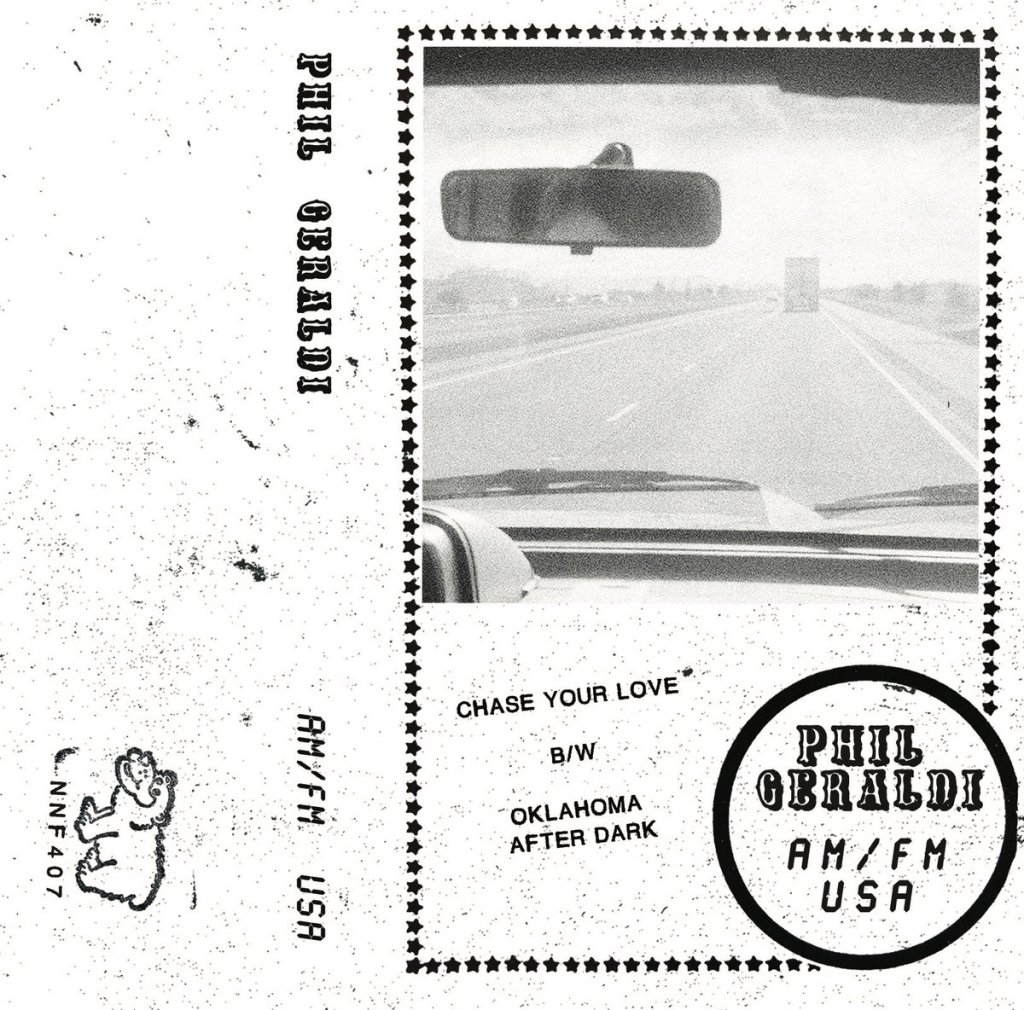
Works like aforementioned by Lia Kohl, Amy Cutler, and Klein join what labels like Full Spectrum or Paisley Shirt are doing, along with albums like Wesley’s Convertible Tape Due for the South by April Magazine, The Continuous Monument by Present Electric, and everything that can be classified under the relatively new tag of “ambient Americana”: on AM/FM USA Geraldi is “trying to fuse country music and a meditative ambient type of music,” he said in a recent interview with The Wire, with in mind the experiments of James Ferraro in which “the most underground punk music [was] combined with this weird, meditative, blissful ambient.” However, if an album like Lia Kohl’s The Ceiling Reposes exploits all the potential of a sonic multiverse, cutting and juxtaposing different fragments of different lived worlds, Phil Gerardi employs radios as musical instruments to convey a specific narrative time – his ‘hic et nunc.’ The two extended jams of AM/FM USA seem to tell a story – his journey. Radios are used as low-fidelity noise generators that swiftly transition into a flow of authentic music, interspersed with field recordings, dusty distorted guitars, cricket chirps, percussion, the noise of tires on asphalt, and the hiss of rolling fields sliding on deserted roads. “Chase your Love” fully captures the sensation of a search for lost loves, that, amidst a thousand problems, interferences, and obstacles, concludes in the tranquility of a gentle strumming of a folk guitar fading into the wind. Similarly, “Oklahoma After Dark” seems to narrate a serene night in a state in the South-Central region of the United States. Here, radios have less space, and the sound is saturated with melancholic and whimsical slide guitars, evoking a a full western fashion.
AM/FM USA serves as both an exemplar of how ‘ambient Americana’ should sound in 2024 and a novel form of personal mixtape—an autofiction of sorts, a self-portrait crafted from sonic images that narrates our chaotic and uncertain times.
| versione italiana | o to English version |
L’immaginario americano è un immaginario di viaggio, di frontiere da raggiungere, di spazi da percorrere. È così da prima di On the Road di Kerouac, è così dalla corsa all’oro, dall’espansione nei territori selvaggi a ovest che Larry McMurtry ha raccontato su Dead Man’s Walk e Comanche Moon, e delle incursioni verso il freddo, ostile e inospitale settentrione che sempre McMurtry ha raccontato su Lonesome Dove. Oggi è una ricerca di una frontiera interiore, immaginaria e immaginata, come avviene su Lost Children Archive di Valeria Luiselli: una road novel, certo, ma anche un romanzo costruito di ricordi, impressioni di viaggio, immagini, vecchie polaroid sfocate e, soprattutto, canzoni. Musica sentita di sfuggita, musica scelta, musica casuale alla radio tutta intramezzata da chiacchiericci umani e rumori ambientali.
Accanto alla dimensione spaziale però, il secondo novecento ha sovrapposto una dimensione sonora, quasi un flusso temporale costruito da una polifonia di voci che perdono il loro contesto, si fondono in un rumore fatto di significati sovrapposti. È quanto voleva fare John Cage con Imaginary Landscape No. 4 e quello che di recente ha fatto Lia Kohl su The Ceiling Reposes, ma anche i pastiche post-moderni di touch by an angel e Stars in he Hood di Klein e l’archeologia personale di Sister Time di Amy Cutler.
AM/FM USA è la sintesi di diverse esperienze e di diverse tendenze nella musica americana: innanzitutto la rinascita di un certo modo di usare registrazioni su nastro, un rinato e rinnovato bisogno di raccontare e raccontarsi attraverso la compilazione di mixtape, anche mescolando a docuementi esistenti brandelli di field-recordings e altri detriti sonori. Tutto questo è stato raccontato con tanto dovizia di particolari e grande passione da Marc Masters sul suo recente libro High Bias, un libro che alla fine mostra come la lore musicale del presente sia molto simile a quella ricerca di suoni perduti degli anni ’70 e ’80. Opere come quelle sopracitate di Lia Kohl, Amy Cutler e Klein si uniscono a quanto stanno facendo etichette come Full Spectrum o Paisley Shirt, a dischi come Wesley’s Convertible Tape Due for the South degli April Magazine, The Continuous Monument di Present Electric e a tutto quanto può essere derubricato sotto la relativamente nuova etichetta di “ambient americana”: su AM/FM USA Geraldi “cerca di fondere musica country e una musica ambient più meditativa,” come ha detto in una recente intervista per The Wire, con in mente quegli esperimenti di James Ferrare nei quali “la musica punk più underground [veniva] mescolata con quella strana, meditativa e beatifica musica ambient.” Se però un disco come The Ceiling Reposes di Lia Kohl sfruttava tutte le potenzialità di un multiverso sonoro, ritagliando e giustapponendo diversi frammenti di diversi mondi vissuti, Phil Gerardi usa le radio come strumento musicale per raccontare un tempo narrativo preciso, il suo qui e ora. Le due lunghe jam di Am/FM USA sembrano raccontare un viaggio, il suo viaggio. Le radio vengono usate come un vero e proprio strumento musicale, un generatore di rumori a bassa fedeltà che presto lasciano spazio a un fiume di pedal-steel, di musica reale che sembra uscire da una vecchia radio, inframezzata da field recordings, polverose chitarre distorte, canti di grilli, rumore di pneumatici su asfalto, sibili di rotolacampi che scivolano su strade deserte.
“Chase your Love” dà appieno la sensazione di una ricerca in viaggio che tra mille problemi, interferenze e ostacoli, termina nella quiete di uno strumming gentile di chitarra folk che si spenge nel vento. Allo stesso modo “Oklahoma After Dark” sembra raccontare una placida notte in uno stato del centro sud degli Stati Uniti. Qui le radio hanno meno spazio e il suono è satollo di slide guitar malinconiche e folleggianti. Am/Fm USA funziona sia come un esempio di “ambient americana” nel 2024 e come nuova forma di mixtape personale—una sorta di autofiction, un autoritratto per immagini sonore che raccontano i nostri tempi caotici e incerti.
 listening wind